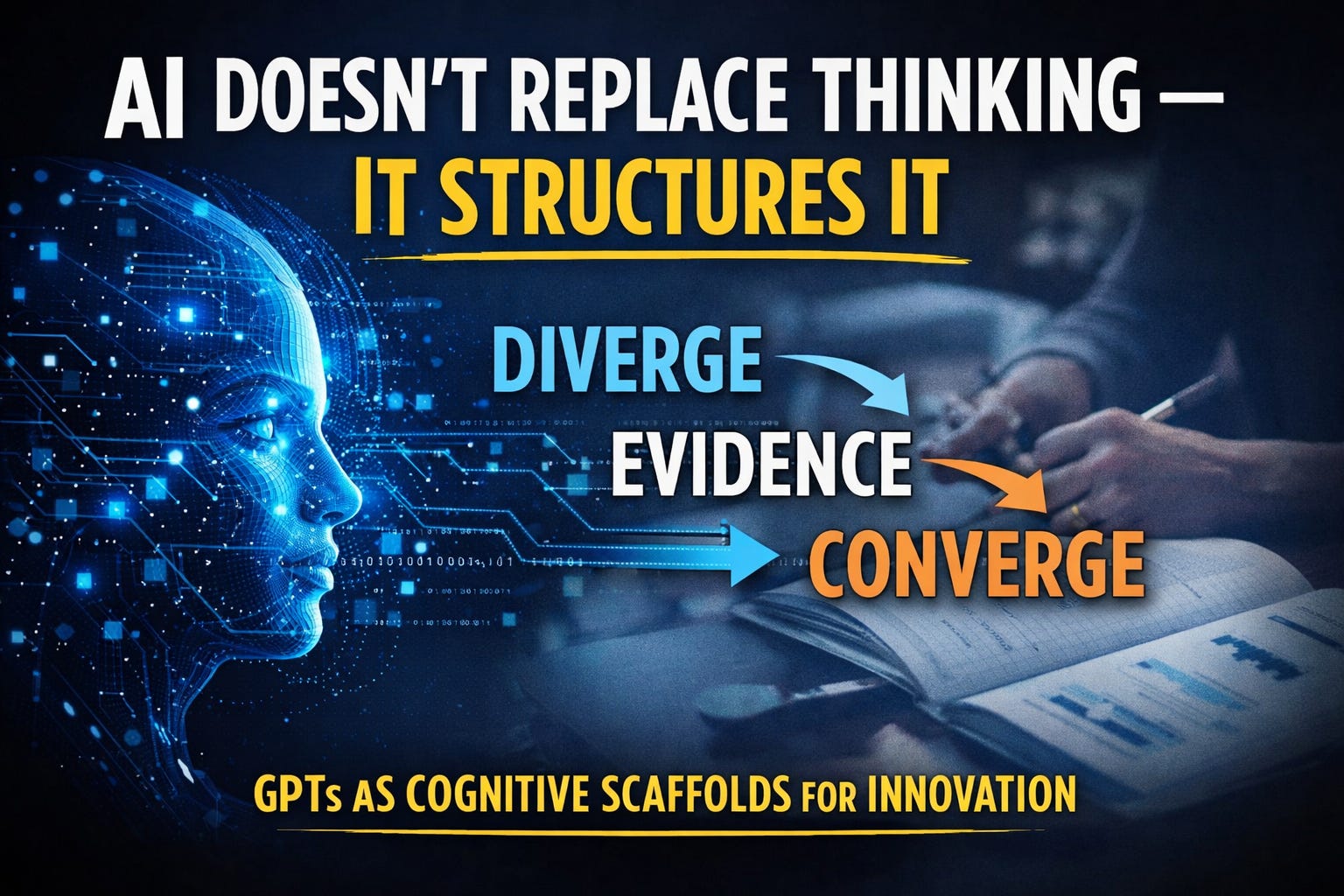
AI Doesn’t Replace Thinking — It Structures It
Why purpose-built GPTs may be the most important innovation pedagogy shift in decades

There is a growing fear that AI is making students lazy.
That AI will replace thinking.
That it will generate polished answers without understanding.
That learning will become superficial.
If AI is used as an answer machine, those fears are justified.
But when AI is designed differently — when it is embedded into a structured innovation process — something surprising happens.
AI does not weaken thinking.
It disciplines thinking.
This distinction sits at the heart of a teaching approach I use across innovation, entrepreneurship, and technology commercialization courses. Participants do not use open-ended AI. They interact with purpose-built GPT agents designed as structured cognitive scaffolds within a multi-stage innovation journey.
The goal is not to generate answers.
The goal is to improve decision-making under uncertainty.
The Real Problem in Innovation Education
The biggest challenge in teaching innovation is not idea generation. It is premature convergence.
Participants naturally jump from:
problem → solution
They embed assumptions, narrow too quickly, and begin optimizing before they understand the problem. This is not a student issue. It is how humans make decisions under uncertainty. We seek closure. We prefer certainty. We gravitate toward familiar solutions.
But innovation requires the opposite behaviour. It requires staying open longer, exploring alternatives, and progressively refining understanding.
This is why the pedagogy is built around a simple but powerful rhythm:
Divergence → Evidence Gathering → Convergence
Not once — but repeatedly across the entire innovation journey.
Why Open AI Use Often Makes This Worse
Unstructured AI encourages exactly the behaviour we are trying to avoid. Ask a general AI system a question and it produces a polished answer. It looks convincing. It feels complete. It encourages premature convergence.
The result is faster answers — but weaker thinking.
Purpose-built GPTs reverse this dynamic. They do not provide solutions. They structure exploration. They challenge assumptions. They ask participants to justify reasoning. They encourage alternative framings. They highlight missing evidence.
The GPT is not thinking for participants.
It is slowing them down in the right places.
Supporting Divergence Without Chaos
One of the hardest skills in innovation is divergence. Participants tend to embed solutions into problem statements, assume root causes, and focus on familiar users. Designed GPTs counteract this by expanding the thinking space. They encourage multiple framings, alternative stakeholders, and competing hypotheses.
This is not brainstorming. It is structured divergence. The GPT helps participants explore without prematurely narrowing, while still maintaining discipline.
The result is not more ideas.
It is better problem understanding.
Evidence Gathering: Where Learning Happens
Divergence without evidence is just speculation. The most important stage in the innovation process is evidence gathering. This is where assumptions are tested and understanding evolves.
Purpose-built GPTs play a critical role here. Instead of providing answers, they ask probing questions. They challenge logic, surface contradictions, and encourage participants to identify what they still need to learn. Participants must gather the evidence themselves. The GPT acts as a reflective partner, not a solution generator.
This interaction strengthens metacognitive skills. Participants become more aware of their reasoning, their assumptions, and their blind spots. The learning occurs in the dialogue, not the output.
Convergence as a Temporary Best Explanation
Only after divergence and evidence gathering do participants converge. Even then, convergence is treated as a temporary synthesis. The goal is not certainty, but clarity. Participants refine their framing, prioritize stakeholders, and articulate value propositions.
The GPT structures reasoning, but participants make decisions. This preserves human judgment while strengthening analytical discipline.
Confidentiality Enables Real Learning
A critical feature of this approach is that participant inputs remain confidential to them. This creates psychological safety. Participants can explore uncertain ideas, revise assumptions, and test alternative directions without evaluation pressure.
Innovation thinking requires vulnerability. Early ideas are incomplete. Assumptions are fragile. Confidential interaction allows participants to iterate honestly. The GPT becomes a private reflective workspace, enabling deeper learning.
Multi-Stage Learning Rather Than Fragmented Exercises
Innovation is not a single step. It is a journey. Each stage builds on previous insights. Purpose-built GPTs support this by enabling multi-stage continuity. Participants can carry outputs forward, refine them, and reuse them in subsequent stages. This can occur through chained GPT interactions or through structured exports that are imported into the next stage.
This continuity transforms learning. Participants see their understanding evolve. They revisit assumptions. They refine framing. They experience innovation as an iterative process rather than a sequence of disconnected exercises.
AI as a Cognitive Scaffold
The key insight is simple: AI should not replace thinking. It should structure thinking.
Unstructured AI is like giving participants a blank search box. Purpose-built GPT pedagogy is closer to a guided learning journey. AI functions as a reflective coach, a structured workbook, and a decision-support framework — all embedded into the innovation process.
The emphasis shifts from generating answers to improving understanding.
The Most Important Outcome
This approach does not aim to accelerate idea generation or automate decision-making. It aims to develop disciplined thinking under uncertainty. Participants learn to resist premature solutions, seek evidence, refine framing, and make structured decisions.
AI supports this process, but the learning comes from the journey.
The real promise of AI in education is not automation. It is structured cognition. When embedded into a divergence, evidence gathering, and convergence process, purpose-built GPTs do not reduce thinking. They make better thinking possible.
And in innovation — where uncertainty is unavoidable — that may be the most important capability we can teach.