When Legitimacy Slows Learning
Why Universities and Governments May Be Even Less Equipped for Disruption Than Corporations

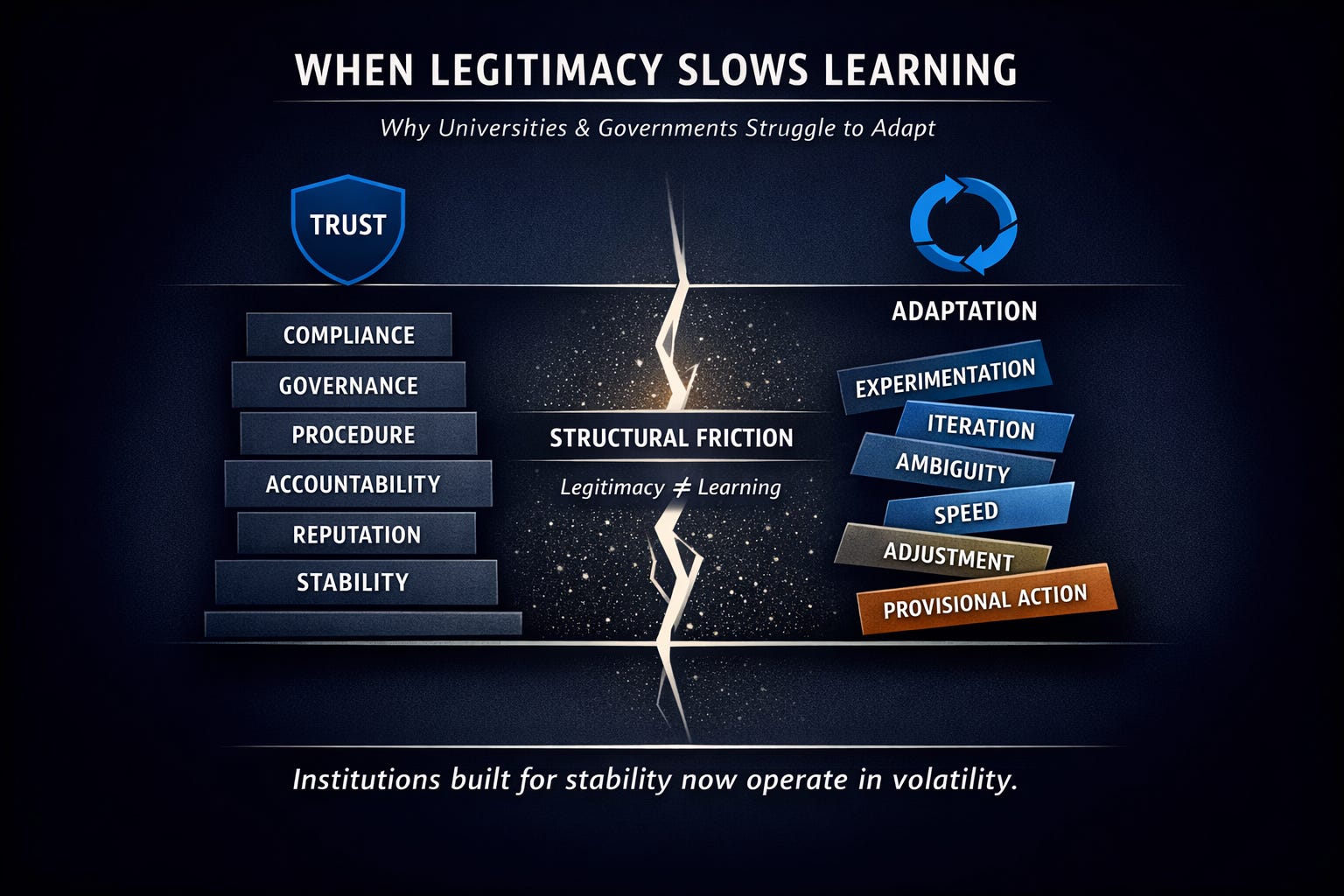
(Article 3 in the Series on Innovation, Leadership, and Organizational Adaptation)
In the first article of this series, I argued that most organizations are designed not to innovate. Not because they lack talent or ambition, but because their structures, incentives, and governance systems were built for stability rather than volatility
.In the second article, I suggested that even intelligent leaders move slowly under uncertainty. The instinct to wait for clarity—once prudent—now increases risk
.This third article widens the lens.
If corporations struggle with structural inertia and decision inertia, universities and government institutions face an even deeper constraint.
Not because they lack intelligence.
Not because they lack public purpose.
But because they are designed to protect legitimacy.
And legitimacy and learning operate according to very different logics.
The Governance Paradox
Corporations are designed to pursue performance.
Universities and governments are designed to preserve trust.
Corporate boards focus on capital allocation and risk oversight. Universities protect academic freedom, peer review, and scholarly credibility. Governments safeguard procedural fairness, compliance, and public accountability.
These logics are essential. They protect societies from corruption, politicization, and abuse.
But they also shape behaviour.
Systems designed to protect legitimacy tend to privilege:
procedural consistency over speed
defensibility over experimentation
documentation over iteration
consensus over decisive trial
In stable environments, this works.
In volatile environments, it becomes constraining.
The paradox is subtle but powerful:
The more an institution is structured to protect legitimacy, the harder it becomes to experiment in ways that might temporarily disrupt it.
Universities: Rich in Ideas, Constrained in Adaptation
Universities generate knowledge. They train leaders. They host world-class expertise across disciplines.
Yet institutionally, they often struggle to adapt.
University governance is deliberately layered: committees, distributed authority, tenure protections, disciplinary boundaries, multi-year budgeting cycles tied to enrolment and public funding.
These systems evolved to protect academic integrity.
They were not designed for rapid institutional redesign.
When artificial intelligence begins reshaping labour markets, universities debate curriculum reform. When digital delivery models emerge, institutional identity complicates adoption. When funding models shift, internal politics frequently override strategic recalibration.
Faculty often see disruption clearly.
But incentive systems reward publication and grants—not institutional experimentation. Promotion metrics privilege disciplinary depth—not cross-boundary innovation. Administrative processes emphasize compliance and defensibility—not speed.
The result is not intellectual blindness.
It is structural friction.
The longer adaptation is delayed, the more external forces reshape education without the university’s input.
Government: Accountable by Design, Cautious in Practice
Government agencies face even tighter structural constraints.
Procurement rules exist to prevent corruption. Audit frameworks ensure accountability. Political oversight protects democratic legitimacy. Transparency requirements safeguard fairness.
All of this is necessary.
But together they produce long decision cycles and visible penalties for failure.
Public servants may recognize the need for experimentation. Yet pilot programs require multiple approvals. Budget reallocations face political scrutiny. Electoral cycles compress long-term thinking into short-term optics.
Unlike corporations, governments rarely experience immediate market discipline. Decline is gradual and diffuse.
This creates a powerful asymmetry:
Visible failure is punished quickly.
Invisible stagnation is tolerated quietly.
In stable environments, this asymmetry is manageable.
In volatile ones, it becomes dangerous.
Legitimacy vs Learning
At the heart of this challenge lies a deeper tension.
Legitimacy requires consistency, transparency, and defensibility.
Learning requires experimentation, ambiguity, iteration, and provisional action.
James March described the tension between exploitation and exploration decades ago. Most universities and government institutions are structurally weighted toward exploitation—refining and safeguarding existing systems.
Exploration remains peripheral.
But when environments shift discontinuously, exploration is not optional.
Michael Tushman and Charles O’Reilly argue that ambidexterity—the ability to pursue both efficiency and experimentation—is possible. But it requires structural separation and leadership alignment.
It does not emerge from rhetoric.
Amy Edmondson reminds us that experimentation requires psychological safety. Yet many public systems conflate intelligent failure with incompetence.
The collision between legitimacy and learning is not theoretical.
It is operational.
AI as an Institutional Stress Test
Artificial intelligence magnifies these tensions.
Universities teach AI while struggling to integrate it institutionally. Debates about academic integrity, assessment models, and authorship unfold while students adopt tools immediately.
Governments regulate AI while often lagging in internal deployment. Policymakers wrestle with ethical concerns while startups iterate at speed.
The issue is not whether caution is appropriate.
It is whether caution has become structural rigidity.
AI reduces the cost of experimentation dramatically. It allows rapid prototyping, iterative testing, and accelerated learning cycles.
Institutions optimized for deliberation must now learn how to experiment without undermining legitimacy.
That is not a minor adjustment.
It is a governance redesign problem.
Identity as Inertia
Beyond metrics and governance lies something deeper: identity.
Universities define themselves around scholarship and intellectual authority. Governments define themselves around stability and control of risk.
Identity provides coherence.
But it can also become inertia.
Institutions cling to the version of themselves that made them legitimate—even when environments demand reinterpretation.
Academic freedom does not require institutional stagnation.
Public accountability does not require procedural paralysis.
Legitimacy does not require rigidity.
But redesign requires acknowledging the tension rather than denying it.
The Stakes Are Higher Than Corporate Failure
When corporations fail to adapt, markets reallocate capital.
When universities and governments fail to adapt, consequences ripple across society.
Skills misalign with labour markets. Innovation systems fragment. Public trust erodes. Policy lags technological change.
The institutions society depends on most during periods of disruption may be the least structurally equipped to adapt quickly.
That is not an indictment.
It is a design observation.
And design can change.
What Comes Next
Paper 1 argued that organizations are designed not to innovate.
Paper 2 showed how decision logic reinforces delay.
Paper 3 reveals that institutions built to protect legitimacy face even stronger structural friction.
The final article in this opening series will turn fully to design.
If stability was once the objective, how do we build adaptability without sacrificing legitimacy?
How do we design governance systems that protect trust while enabling experimentation?
How do we redefine risk so that learning is valued as highly as compliance?
And how does artificial intelligence become an enabler of adaptive institutions rather than a destabilizing force?
In volatile environments, legitimacy alone is not enough.
Intelligence alone is not enough.
Intent alone is not enough.
What matters is adaptive capacity.
And adaptive capacity can be built.
That is where we turn next.
If I may bring out my inner cheerleader, you are nailing it Prof Maxwell.